Key Takeaways
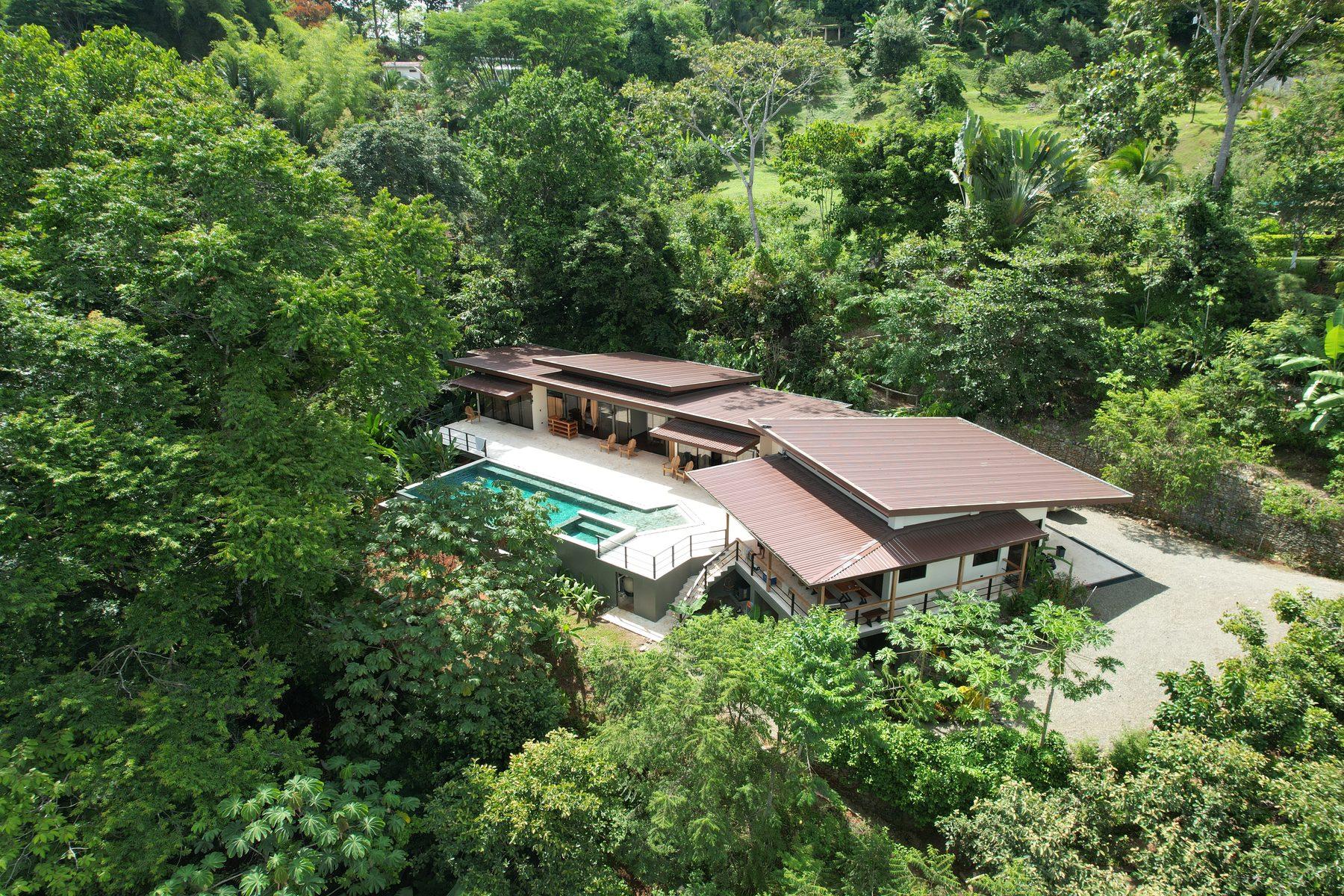
- Casa Cavu is our family's completed luxury jungle villa in Platanillo, in the hills above Dominical. Four bedrooms, six bathrooms, sleeps 12, with an infinity pool, hand-cut mosaics, and red cedar ceilings throughout.
- The villa is a short drive from Finca Magnolia, our family farm, about 20 minutes away, and its waterfalls, rivers, and trails give the whole Platanillo area a specific feel most high-end rentals in Costa Rica cannot replicate. The villa itself sits on its own private jungle land with its own trails.
- Building a luxury villa in the Southern Zone is less about the finishes and more about getting the fundamentals right. Legal water, all-season road access, drainage on a hillside, and local craftsmen who understand tropical construction.
- Platanillo is a quieter inland location than coastal Dominical or Uvita. It stays cooler, the air is clearer, and the Pacific is still 15-20 minutes away. For buyers who want jungle feel with easy beach access, this corridor is one of the best positions in the Southern Zone.
- Casa Cavu doubles as a vacation rental at casacavucr.com when our family is not using it, which is a common ownership model in the Southern Zone for homes of this scale. The economics only work with professional operation, not casual listing.
- If you are thinking about building or buying a luxury villa in the Dominical area, the lessons from Casa Cavu are practical: trust the local trades, over-invest in the parts that touch the climate (roof, drainage, water), and buy land with legal fundamentals already resolved.
A luxury villa in the Dominical hills is not just a bigger house with a nicer pool. It is a specific way of living in Costa Rica's Southern Zone, surrounded by jungle, open to the ocean breeze, built around the sounds of rivers and howler monkeys in the morning. We built Casa Cavu because we wanted that life for our family, and this is the story of how it actually came together.
This is not a sales pitch for a listing. Casa Cavu is not for sale. We wrote this piece because we are regularly asked what it actually takes to build or buy a luxury villa in the Dominical area, and the honest answer is more interesting than the brochure version. Here is what we learned.
Why We Chose the Dominical Hills (and Specifically Platanillo)
Our family has worked in Costa Rica real estate for years, which gave us the unusual advantage of being able to pick almost anywhere on the Southern Pacific coast. We chose the hills above Dominical, specifically Platanillo, a quiet inland community about 15-20 minutes from the beach.
A few reasons it kept coming back as the right answer:
The climate is noticeably different from the coast. Platanillo sits at enough elevation that the heat and humidity drop meaningfully. It is cooler at night, the air is drier in dry season, and the mornings have a different quality to them. For a home we would actually use year-round, that mattered more than squeezing out a slightly closer beach distance.
The jungle is real here. Not landscaped jungle, actual primary and secondary rainforest with wildlife that shows up on its own schedule. Howler monkeys, toucans, a lot of insect life. The villa's own trails and private jungle land are right outside the door. About 20 minutes away, our family's other project (Finca Magnolia) adds hundreds of acres of waterfalls, rivers, and trails as part of the broader Platanillo corridor we enjoy as a family.
Access is quick without being on top of the highway. Getting to the beach at Playa Dominical or Playa Hermosa is a 15-20 minute drive. Uvita for additional services, dining, and the Marino Ballena National Park is another 10-15 minutes south. San Isidro de El General for a full hospital and larger shopping is about 30-40 minutes inland. That cluster of accessible services, without having the Costanera highway in your line of sight, is a specific Platanillo advantage that a lot of Southern Zone buyers underestimate.
Designing the Villa: Materials, Craftsmanship, and the Infinity Pool
The design brief for Casa Cavu was simple in principle and demanding in execution: build a villa that felt genuinely of this place, with materials and craftsmanship that would hold up to the tropical climate for decades, not years.
Four bedrooms, six bathrooms, sleeps twelve. That scale came from the way our extended family actually uses a Costa Rica home, kids, cousins, in-laws, friends visiting from the States. A three-bedroom villa would have felt too tight. A six-bedroom villa would have felt like a hotel. Four bedrooms with en-suite setups hit the right balance for how a family actually spreads out when everyone is here together.
Red cedar ceilings throughout. Costa Rican red cedar is one of the best materials we could have chosen for the climate. It handles humidity, has natural pest resistance, and ages into a deep warm tone rather than looking tired. Every ceiling in the villa is cedar.
Hand-cut mosaics. The tile work on the pool, the bathrooms, and specific accent walls was done by hand, not pre-made. That is slower and more expensive than pattern tile from a box, and it is what makes the villa feel site-specific rather than templated. If you walk through, you can see where individual craftsmen made judgment calls.
The infinity pool. The pool is positioned to drop off the view-side of the house, with the water line visually connecting to the jungle canopy. It is a hallmark of serious Southern Zone villas and the single feature that separates a luxury property from a very nice home. It is also, to be honest, one of the most expensive single-line items in a build like this. A pool like this requires engineered concrete, specialized plumbing, and a variable-speed pump system to run efficiently without wrecking your electrical bill.
Looking at it from the other direction: a lot of the money in Casa Cavu went into things you cannot see. The foundation, the drainage, the roof structure, the retaining walls, the electrical and water systems. In the Southern Zone, those are the parts that determine whether a villa stays a villa after ten years of rain and humidity, or starts to show problems.
Life on the Property: Wildlife, the Farm, and What Is Nearby
What makes Casa Cavu feel different from most luxury homes in the Dominical area is what sits around it. The villa has its own private trails and jungle on the property. About 20 minutes away is Finca Magnolia, our family's 219-acre nature development with waterfalls, natural swimming holes, river access, and more jungle trails.
Day-to-day, that means a few specific things:
Wildlife shows up every day. Howler monkeys in the mornings, white-faced capuchins through the week, toucans and scarlet macaws passing overhead. Not as a tourist experience, as the ambient condition of the place. You hear it from the pool, from the bedrooms, from the kitchen.
The villa's own trails run through private jungle land. Guests and family can step off the pool deck, follow the paths, and be surrounded by rainforest without getting in a car. For a lot of buyers researching the Southern Zone, this is the feature most high-end rentals cannot deliver, that they are not actually surrounded by nature, they are adjacent to it from a manicured property.
Beaches and surf are a short drive. Playa Dominical for the main surf break, Playa Hermosa de Uvita for calmer family beach, Playa Ventanas for the cave formations at low tide. The Nauyaca Waterfalls hike is 15 minutes toward the mountains. The Marino Ballena National Park and the Whale's Tail sandbar are 20-30 minutes south in Uvita.
Dominical town is right nearby for day-to-day groceries, cafes, and local commerce. Uvita is a short drive further for additional restaurants, yoga studios, and the Marino Ballena corridor. Serious shopping or medical appointments usually route to San Isidro.
Owning It as a Vacation Rental
When our family is not at Casa Cavu, the villa operates as a vacation rental under our other brand at casacavucr.com. This dual-use model, family home plus professionally managed rental, is a common ownership structure in the Southern Zone for homes of this scale.
A few honest observations, without specific income numbers:
The economics only work with professional operation. A luxury villa listed casually on a single platform with no on-the-ground management does not perform at the level the property deserves. There is a real difference between a home that generates meaningful rental revenue and one that generates low-margin stress. The difference is almost always the operation, not the property itself.
Short-term rental demand in the Southern Zone is seasonal but real. December through April is the high season. May through November is slower but not dead, especially for properties that can host longer stays or wellness-oriented groups.
The buyer profile for a villa-rental investment is specific. Not everyone wants to own a home that also hosts strangers when they are not using it. Owners who like the dual-use model usually treat the rental side as a way to make the home easier to maintain and more actively lived-in, not as a primary investment return.
If you are evaluating a luxury Dominical-area villa as an investment-plus-personal-use property, we cover the Dominical investment-property economics in more detail on our Dominical investment property page. The short version: the properties that perform combine a strong physical asset with professional, active operation.
What This Means If You Are Thinking of Buying or Building in the Southern Zone
The practical lessons from Casa Cavu apply to anyone evaluating a luxury villa in the Dominical area, whether you are looking at Dominical ocean-view homes for sale, considering land for a custom build, or researching the broader Southern Zone market.
Trust the local trades
Costa Rican craftsmen who have spent their careers building in the Southern Zone tropical climate know things that a general contractor from elsewhere does not. How much overhang the roof needs, how to ventilate a crawl space so the structure breathes, which woods hold up and which do not, which paint systems actually last. The best outcomes we have seen come from buyers who treat the local trades as the experts they are, not as cheap labor to be managed.
Over-invest in the parts that touch the climate
Roof, drainage, water systems, foundation, electrical. These are the parts that determine whether the villa stays a villa or starts needing expensive remediation. Finishes you can upgrade later. A failing roof in rainy season is not a finish problem.
Buy land with the legal fundamentals already resolved
A lot of beautiful Southern Zone parcels have hidden-but-fixable issues: unclear water concessions, access easements that are not actually recorded, title discrepancies, SETENA environmental review requirements that nobody has started yet. Fixing these after closing is more expensive than fixing them before. The best first move on any serious land purchase is a full title study and a water-and-access audit before any offer goes firm. Our guides on the Costa Rica Maritime Zone (ZMT) and the INVU alineamiento fluvial process cover the two legal items that most often surprise first-time Costa Rica buyers.
Match the property to how you actually live
This is the piece that is hardest to articulate and the most important. A luxury villa in Platanillo is not the same lifestyle as a villa on the Uvita ridge, which is not the same as a villa on the Escaleras ridge above Dominical. Each location has a specific daily rhythm, climate profile, community mix, and set of tradeoffs. The buyers who are happiest long-term chose location based on how they wanted to live every day, not just which view photographed best during the showing.
The Bottom Line on Luxury Villas in the Dominical Area
Casa Cavu exists because we wanted to live a specific way in Costa Rica's Southern Zone, surrounded by real jungle, with a villa that genuinely holds up, close enough to beach and town to feel connected, far enough to feel at home. Everything we learned along the way is now part of how we advise other buyers in this market.
If you are thinking about buying or building a luxury villa in the Dominical area, Platanillo, the Escaleras ridge, Uvita Hills, or anywhere in the Costa Ballena corridor, the questions worth asking first are not about the finishes. They are about the fundamentals: how the land actually behaves in rainy season, what the water situation is, who is going to build it (or who built the one you are buying), and whether the location matches the life you actually want to live here.
When you are ready to have that conversation, browse our current Southern Zone listings or send us a note. We will give you a straight read on any property you are looking at, and the lessons from building Casa Cavu are part of what we bring to every conversation.
References
- Casa Cavu vacation rental site, casacavucr.com
- Finca Magnolia project page, /projects/finca-magnolia
- Casa Cavu project page with build journey, /projects/casa-cavu
Ready to explore what’s available?
The Cavu team lives and works in the southern zone. We know every road, every ridge, and every listing worth your attention.
Explore local real estate markets:
Dominical real estate · Uvita real estate · Ojochal real estate · Southern Costa Rica real estate
Related buyer-intent pages:
Casa Cavu project page · Dominical real estate · Dominical ocean view homes · Platanillo real estate · Finca Magnolia · Browse current listings
Frequently asked questions
Casa Cavu is in Platanillo, a quiet community in the hills above Dominical in Costa Rica's Southern Zone. It is adjacent to Finca Magnolia, our family's 219-acre nature development. The villa is approximately 15-20 minutes by road from Playa Dominical and 25-30 minutes from Uvita and Marino Ballena National Park.
Platanillo sits at elevation in the hills inland from the coast. The climate is noticeably cooler and drier than the beach-adjacent Dominical, Uvita, and Ojochal corridor. The jungle feels more immediate (less landscaped, more wildlife), and the day-to-day is quieter. The tradeoff is you are not walking to the beach, you are driving 15-20 minutes. For families who want jungle living with easy coastal access, Platanillo is one of the strongest locations in the Southern Zone.
Casa Cavu itself is not for sale, it is our family villa. But luxury villas with comparable scale and build quality do come to market in the Dominical, Uvita, and Ojochal area regularly. Pricing for well-built 3-5 bedroom luxury villas with pools and ocean or jungle views typically starts around $900K-$1.2M and runs to $3M+ for premium Escaleras ridge or Uvita Hills properties. Browse current inventory on our [Dominical ocean-view homes page](/dominical-ocean-view-homes) or [contact us](/contact) to discuss what's available.
Costa Rica Southern Zone construction costs for quality mid-to-high-end custom homes in 2026 typically run $180-$280 per square foot of finished area. Hillside sites add 10-30% for foundation, retaining, and access work. Premium finishes, infinity pools, hand-cut tile, imported materials, and complex architecture push costs higher. A realistic all-in budget for a 4-bedroom luxury jungle villa with pool typically falls between $1M and $2M depending on site complexity and finish level, on top of the land purchase.
Yes. Foreigners can own titled property in Costa Rica with the same rights as Costa Rican citizens, no residency required. Almost all Southern Zone villa properties, including Casa Cavu's area, sit above the 200-meter Maritime Zone (ZMT) line as standard titled fee-simple property. The legal path is straightforward: title study, escrow, notary closing. For properties actually inside the ZMT (true beachfront), different rules apply, we cover that in our [Costa Rica Maritime Zone guide](/costa-rica-real-estate-market-guides/costa-rica-maritime-zone-concession-vs-titled-property).
Yes. When our family is not using it, Casa Cavu is available as a vacation rental at casacavucr.com. The villa sleeps up to 12 across 4 bedrooms with 6 bathrooms, with the infinity pool, access to Finca Magnolia's trails and waterfalls, and professional management on-site.
Source: Original article